Monday, 4 July 2016

Genre Lesson: Bollywood Musicals

Rang de Basanti
To educate myself on one of my favourite art forms, film, I occasionally hold film festivals for myself and any willing participants (who are rare). I have done this for 1950s science fiction, American war films, and film noir. I know these genres well enough already, though. To push myself further, this spring I chose a genre that I have avoided because I was certain I would hate it: Bollywood musicals, or more properly, Hindi popular film. I expected to be horrified by the stock characters and sentimental plots, but I wanted to learn something new. Maybe I was being judgmental for no reason.

I scoured the Internet for "best of" lists and cross-checked them with my local library's holdings. I came up with a four-film list, and away I went.

The first film I saw was Rang de Basanti (2006). I chose it both because I found it on more than one list and because I have a song from the soundtrack in one of my playlists, having become intrigued by composer A.R. Rahman after watching Slumdog Millionaire. Before Rang de Basanti, that film was the closest I had come to seeing a Bollywood musical. As I expected, I thought Rang de Basanti had an amateurish approach to characterization and plot. I also expected more dancing. I was surprised, however, by the film's invocation of the history of Indian separatism. The ending also shocked me: it was more like the end of the second season of True Detective than a musical.

I needed a more centre-of-spectrum specimen.
Kabhi Khushi Kabhie Gham

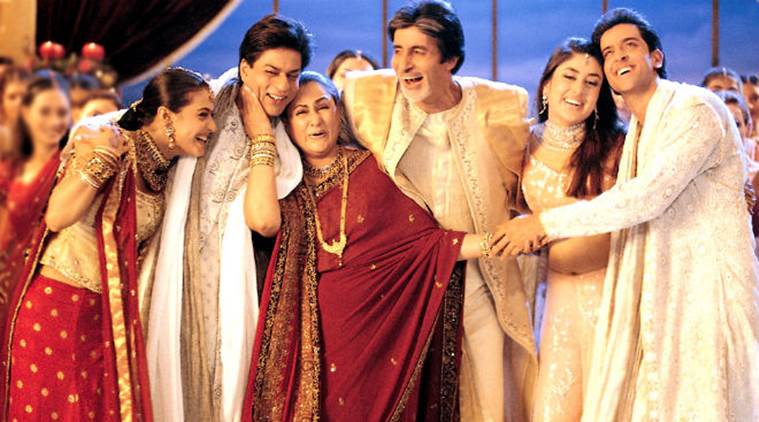
I think I found that specimen in Kabhi Khushi Kabhie Gham (2001). This is three hours of improbably impromptu dancing, slow motion shots of lovers blinking at their beloveds, formal religious festivals with traditional costumes to reinforce the genre's conservatism, and plenty of stock characters. I was impressed by the melodrama. The young actors were almost painfully handsome, and the film gave plenty of attention to their physical appearance. The title translates as Through Smiles and Through Tears, and indeed there is plenty of crying. Whole sequences involve close ups of different people looking at each other with tears welling in their eyes. All emotions run high: when the father, played by Bollywood's legendary Amitabh Bachchan, pronounces his disapproval over his son's choice of bride (a standard plot element in Bollywood popular cinema), the sound of lightning and thunder punctuates every sentence. The sentimentality and the music-video dancing interludes fulfilled my expectations.

These expectations were tempered somewhat in my third film-festival entry.
Anand
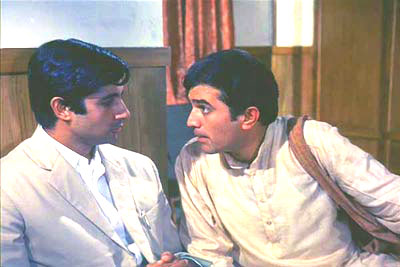
Anand (1970) was made a few decades before K3G. It features a much younger Amitabh Bachchan as a doctor who cares for a man who is dying of intestinal cancer.  The emphasis in this story is the dying man's cheerfulness despite his certain death and his desire to bring the stiff, lonely doctor out of his shell. The illness gives many opportunities for sad songs. Unlike the musical numbers of the other films, the singing is more contemplative than social. Rajesh Khanna, the actor who plays the dying Anand, sings (or rather, lipsyncs to a track) while walking alone on the beach, standing on a veranda or strolling through the town streets. The dance number is reserved for a scene where Anand auditions for a local drama group and sees the rehearsal for a dance number.


"Hey, I know that guy! I love that guy!"
Finally, I watched Devdas (2002), one in a long line of films based on the Bengali novel of the same name. I recognized Shah Rukh Khan,a  main character from K3G. ("Hey, I know that guy," I said to myself. "I love that guy!") I also recognized, albeit belatedly, Aishwarya Rai, who I had seen in The Pink Panther 2. By this point in my education, I was able to see where the film followed and deviated from the genre as I had come to know it.  Much like K3G, the emphasis was on visual splendor and musical numbers. Unlike K3G, the story is a tragedy rather than a comedy. I appreciated the turn away from expectation, but I had to sit through some of the things I didn't enjoy about K3G: the endless tears, the slowness of plot development, the simplicity of characterization, and the insistence on creating a glitzy fantasy world for its characters to live in.

This film helped me identity for myself the genre that it most reminded me of: European opera.  I do not like opera, for the most part, because of its emphasis on visual elements over plot and because of its glacial plot deroulement. Once I saw Devdas and the other films as opera, I was able to both appreciate the genre more and feel secure about letting the genre go from me. I am not giving up on Indian film: I am just saying that I have had my curiosity sated about the type of film that the term "Bollywood musical" conjured for me.

A simple primer for Americans about Bollywood covers the surface features of Bollywood musicals. One of my former postcolonial studies professors, Vijay Mishra, wrote a book on the Hindi film industry, for those who want a more scholarly approach. I may dip into it myself to broaden my Indian film knowledge.
Devdas

Friday, 17 June 2016

Gardening the Creative

File:Chicago World's Columbian Exposition 1893.jpg
World's Columbia Exposition 1893, Chicago (Wikimedia Commons)
For some people, looking after a garden simply involves cutting the grass or watering the plants, but for others, garden design is an art form. Recently, my attention was drawn to the art of the garden in two different places:a book by Erik Larson about the 1892-93 Chicago World's Columbian Exposition  and an interview with English garden designer Juliet Sargeant on CBC Radio's arts program q.


Larson's The Devil in the White City tells the double story of Chicago's struggle to create a rival to the Paris Exhibition in the midst of a nationwide financial collapse and of aserial murderer who preyed on the women drawn to the city during the fair. Among the architects and city planners who worked on the fair was Frederick Law Olmstead, the landscape architect who designed New York's Central Park. The  Chicago exhibition was famous for its large-scale projects: an oversized neoclassical city, the first ferris wheel, and the reconstruction of Algerian, Polynesian and German "villages" in the city's people-pleasing midway. Olmstead, however, insisted that the vegetation and pathways that surrounded and connected these works of wonder would set the emotional tone for the entire space.

The "Modern Slavery Garden" Juliet Sargeant has created
The Modern Slavery Garden, 2016 Chelsea Flower Show
A century and continent away, Sargeant put aside her medical training to become a garden designer. In her exhibit The Modern Slavery Garden for the Chelsea Flower Show, Sargeant creates an allegory for the secret suffering in Britain of  victims of human trafficking. The display, which on the surface looks like a proper English country garden, commemorates the passage of the UK Modern Slavery Act. 

Landscape architecture and garden design require the proper selection of plants to suit a theme or mood, not to mention the practical skills required to place living things in and around inorganic materials. My humble backyard garden is nothing on the scale or the intellectual purposefulness of Olmstead and Sargeant works, but like the heroes in Voltaire's Candide, I do my own little work in my garden.

Friday, 10 June 2016

Creativity and Mental Illness

A couple of years ago The Atlantic published an essay about  research on creativity and mental illness with an emphasis on the work of Nancy C. Andreasen. One conclusion of Andreasen's research is that creative people tend to have mental illness in their families, even if they themselves do not (and many do).  Why this is the case seems to derive from the way that creative people think. They are good as associating ideas with other ideas, which can be both helpful and not helpful to mental health. Associations are not always practical, understandable to others, or even correct.

Andreasen makes other generalizations about creative people that, unlike mental illness, are qualities  somewhat under an individual person's control. Her creative people work hard, probably because they are doing what they like to do. They tend to be self-taught in some areas of knowledge, even if they have a great deal of formal education, and they tend to be interested in many different areas. Creative people take risks, and they are persistent in the face of rejection or failure. Andreasen defines creativity in a way that embraces the arts and sciences equally. John Nash, for example, the subject of the film A Beautiful Mind, was of particular interest to her. (Read her obituary about John and his wife Alicia).

Her most recent long-term study focuses on famously creative people, so her results may be skewed as a result towards those people whose creative work has gained some mainstream acceptance and public accolade. Nevertheless, I think it is worth noting her generalizations and think about their implications for people who are not famous.

Saturday, 4 June 2016

Public Art in Urban Nature

My recent intersection with urban interventionism through 100In1Day has led to another intersection, one that involves walking in my city's vast river valley and ravine complex.

Knowing what I have been up to lately, my husband clued me into the Kinnaird Ravine art walk, and I went along with him with our son and dog to check it out. The KinnArt Ravine project was mounted in early November 2015. Since then, people who walk along one portion of the gravel path through the ravine also pass through a public art gallery. News coverage at the time gives good information on the project and many more photos.


This part of the ravine is so deep and low that it is easy to forget the ravine is in the city's downtown. At first I mourned the now more obvious signs of human activity that the murals present. Of course, my desire for nature to somehow trump human occupation is based on willful illusion: I am well aware that I am in a city when I walk through the ravine. In any event, the paintings replace an existing retaining wall along the trail, so the murals beautify an existing architectural structure.

This project is listed on the website of Make Something Edmonton, the same group that is coordinating 100in1 Day.

News coverage at the time emphasized the community league's desire to discourage the graffitti that covered the previous retaining wall. As one of the organizers pointed out, however, public art is not alien in other parts of the world, such as his home town in Chile.

I sometimes get suspicious about attempts to discourage graffitti, even though I realize that much graffitti is not art. I was pleased, then, to see some graffitti-style murals in KinnArt.

Signs of creativity and positive group effort please me and give fodder for my humble blog too. I salute the artists and organizers of this project.

Monday, 23 May 2016

Shaping community 100in1Days at a time

I have created a project called ReadOut for 100in1Day in Canada. Begun in 2012 in Colombia, 100in1day is an act of "urban intervention" for citizens to improve their cities with simple ideas to create temporary or permanent changes to their communities. Canada's six participating cities have set June 4 as the nation's community day of action.

The urban intervention movement seems rooted in twentieth-century counterculture.In counterculture, subsections of a community build, march, and organize without the permission of official social structures, including government. 100in1Day has connections to folk carnivals and festivals, Dadaism, the American happenings and French situationists of the 1950s and 1960s, the flash mobs of the 2000s, the infiltrations of Pussy Riot, and the Occupy movements. Mimi Zeiger's The Interventionist's Toolkit catalogues 21st century urban interventionism with an emphasize on urban architecture and planning.


Dadaists thought that art as a category should be dismantled because such categorization gathered up the qualities of art and isolated them from other human activities, as though the values of art had no business being integrated with human culture generally. Street art, therefore, especially guerrilla street art such as graffitti, aims to remedy this false categorization and return art to where it belongs: everywhere people live. This connection with street art is manifest in the many 100in1day projects that involve visual art in some way. Murals are popular, for example.

In the case of 100In1Day, local governments seem actively involved in promoting these interventions. Instructions for Edmonton's 100In1Day stress the need to fill out permits and follow bylaws.  I suspect that municipal city planners and nonprofits are desperate to appeal to as many subcommunities as they can and therefore appreciate this self-funnelling of group energies into small-scale activities. Groups can reveal a need or a willingness to cooperate through an urban intervention, and in this display make their cause visible to others, including nonprofit and government agencies. At the same time, land developers and real estate agents, as well as other businesses, sponsor or initiate projects. As a result, some of the interest in this day has a foot in the door of private profit-making.

Perhaps 100In1Day is a cooptation of underground activism for ideological ends. My little project has people reading and waving and talking to people in their neighbourhoods. If one of the things people choose to read on their front lawns is Guy Debord's The Society of the Spectacle, so be it.


Friday, 20 May 2016

Uncheck Your Phone

Tomato seeds in an egg carton
I have a new cellphone, but I plan to use it less. That is, I have pledged to stop checking my phone.

Instead of using up those few moments of my day when I have to wait for something to happen--a file to load, a person to find his debit card in his wallet, a person to come back to the car after running out to buy some milk--I am going to do other things. Checking the phone, at least for me, sometimes takes me away not for a few seconds but for a few minutes. I can accomplish a great deal  that is creative, rather than consumptive (reading ads other people have written, playing games other people have written) in those minutes.

Tomato seedlings in tomato cans
I am not interested in being more efficient. Rather, I am interested in being receptive to the possibilities for creativity. Zones of emptiness that need filling for the sake of being efficient (that is, doing things) becomes zones of plenty.

Instead of checking my phone, I have been able to do the following:

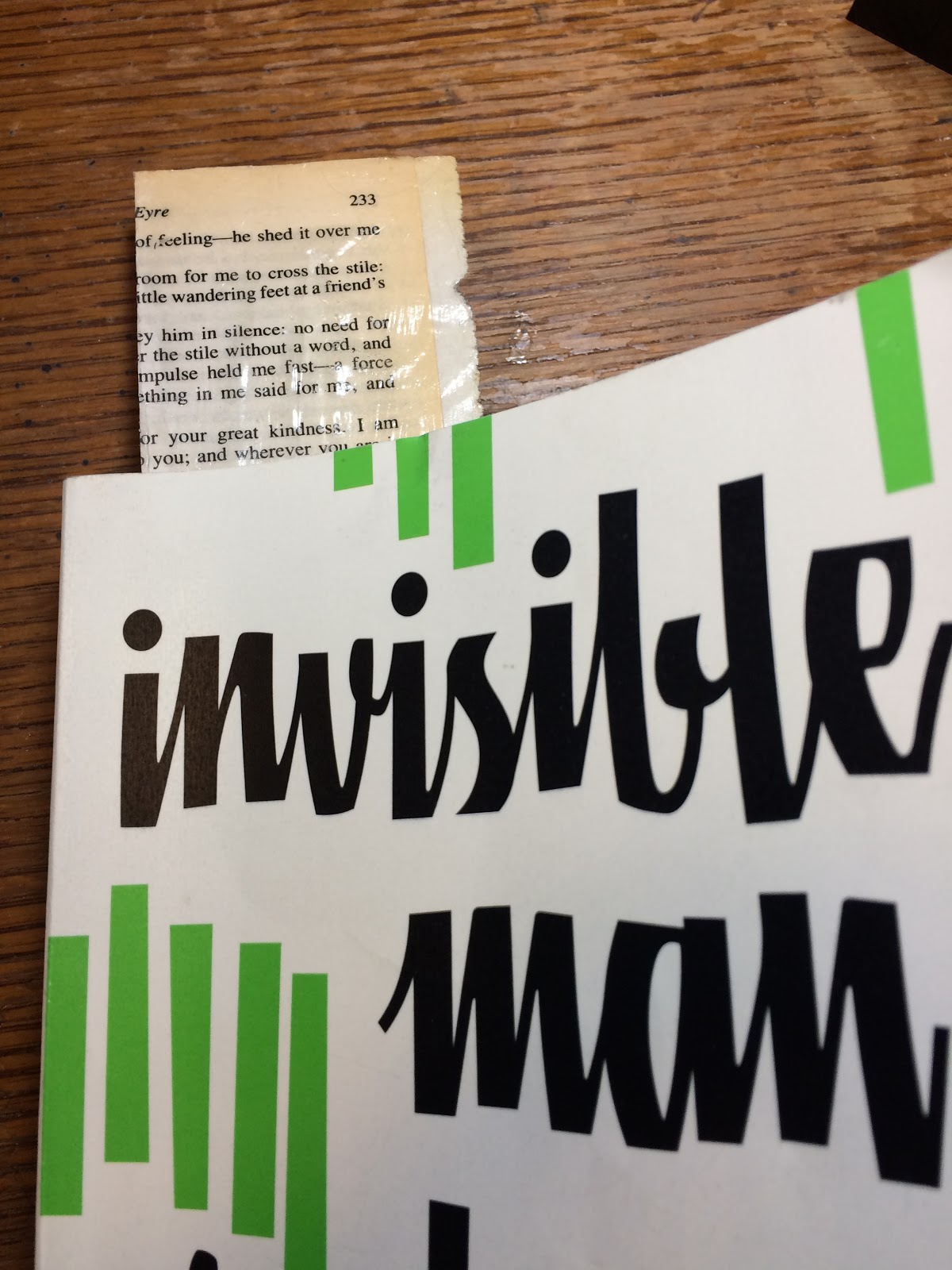
1. Make bookmarks. I started with pages torn out of a spine-cracked Jane Eyre paperback. With a few strokes of a paintbrush in a pot of Modge Podge, I can layer the paper with glue that hardens the pages so they can last for as long as those bookmarks you get at the clinic about health services.


Combination of two anti-phone-checking tactics
2. Start tomato plants from seed. Getting the seed from an  online seed catalogue was as time consuming as playing two rounds of Wordsplay, my usual go-to for passing time. I bought soil at the hardware store, so that trip was the amount of time I would spend watching dachshund-related videos on YouTube. I used egg cartons for seed starting cells, and I planted the seedlings into empty cans of plum tomatoes. Watering the cells took about the same time it takes me to check out new posts on Pinterest.

3. Read snippets from any book or magazine I have lying around, such Invisible Man, pictured here with a bookmark I made.

Saturday, 7 May 2016

Fiction and democracy

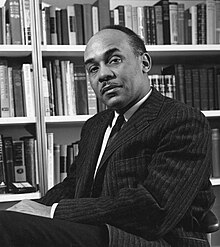
Ralph Ellison photo portrait seated.jpg
Ralph Waldo Ellison (from Wikipedia)
One of my literary heroes, Ralph Ellison, considered art to be essential to democracy. His perspective was of an African-American man in the twentieth century after the Second World War. As the United States goes through an election tumult in 2016, Ellison's views about fiction (my area in the artistic field) and American democracy may convince people that art has a role in elucidating the aims towards which political entities generally should be directed.

In the 1981 introduction to his 1952 novel Invisible Man, Ellison explains the genesis of his novel as a convergence of artistic ambition and  "social responsibility":

"[I]t would seem that the interests of art and democracy converge, the development of conscious, articulate citizens being an established goal of this democratic society, and the creation of conscious, articulate characters being indispensable to the creation of resonant compositional centers through which an organic consistency can be achieved in the fashioning of fictional forms. By way of imposing meaning upon our disparate American experience the novelist seeks to create forms in which acts, scenes and characters speak for more than their immediate selves, and in this enterprise the very nature of language is on his side. For by a trick of fate (and our racial problems notwithstanding) the human imagination is integrative--and the same is true of the centrifugal force that inspirits the democratic process. And while fiction is but a form of symbolic action, a mere game of "as if," therein lies its true function and its potential for effecting change. For at its most serious, just as is true of politics at its best, it is a thrust toward a human ideal. And it approaches that ideal by a subtle process of negating the world of things as given in favor of a complex of man-made positives."

Ellison goes on draw an analogy from Mark Twain's The Adventures of Huckleberry Finn, in which the young white Huck goes on a river adventure on a raft with his friend and slave Jim. Their adventure constitutes a mental space "in which the actual combines with the ideal and gives us representations of a state of things in which the highly placed and the lowly, the black and the white, the northerner and the southerner, the native-born and the immigrant are combined to tell us of transcendent truths and possibilities."  Fiction, then, "could be fashioned as a raft of hope, perception and entertainment that might help keep us afloat as we tried to negotiate the snags and whirlpools that mark our nation's vacillating course towards and away from the democratic ideal."

This view of creativity, then combines art, a widely recognizable avatar of creativity, with political reform. Such reform depends on the willingness to rectify dysfunction by implementing new models of governance. To create new mechanisms for governance requires, of course, creativity. Political reformers, then, as far as Ellison is concerned, could use the skills people develop in reading and writing fiction to power the "centrifugal force" that leads to a desire to modify the status quo.