Thursday, 27 March 2014

Imitation

Mimesis means "imitation" as well as "representation." Imitation of someone else's style can force you to stretch out of the bonds of habit.


Thus the rewrite exercise. Impose a different set of circumstances onto the sentence structure of someone else’s writing. I did it myself. I chose a writing style and structure that I thought was something I wouldn't ordinarily use. 

The original is from Dylan Levi King’s “The 33 Transformation Bodies of the Bodhisattva Guanyin” published in Grain, herewith:

There was a man seated in the back of a flatbed tricycle. His hair was bright white, combed back, and he wore a threadbare black blazer. The man smiled at him from under a pink umbrella trimmed with lace. The procession kept walking. The megaphone chastised the rain. Incense steamed from Guanyin’s shoulders. The rain--
--stirred the sea under her lotus desk and she calmed it with a sweep of her willow branch. She looked up at the clouds. The rain fell and didn’t reach the sea and fell only into the mouth of her ceramic jar. The rain--
--left its cool moisture on her skin.
--fell in juddering waves. The water came to his knees as he walked through the park at Granville and Number Three Road. In the parking lot at Richmond Centre, the water rose to his waist. He climbed the escalator at the SkyTrain terminus station and the water rose to seal him on the platform. The water threw itself against the glass walls of the station. White foam swept along the surface of the water, carrying torches of bull kelp, a yellow hard hat, a crate of oranges, shredded paper. He heard the rain drumming on the blue skylight above him. He saw a train siting a few hundred yards down the track, halfway to the next station at Landowne. The rain--
--emptied into the drain with a dignified, steady gurgle. She sat down at the head of the tub with her legs pulled up against her breasts. She pushed back the shower curtain. Cool air dried the warm water on her face. She folded her legs under her and stood up. She turned off the faucet. The shower curtain held in the last bundles of steam. She reached out and grabbed the heavy white towel, wrapped it around herself, and stood breathing in the steam scented with her roommates’ shampoos and soaps, the smell of her clean white hair.

***  *** *** *** ****** *** *** *** *** *** *** *** *** *** *** *** *** *** ***

My Rewrite

There was a man seated in the front of the club at a small table. His hair was bright blue, tied back with a black velvet ribbon, and he wore a dazzling sequined blazer. The man smiled at Pete from under long fake eyelashes. The room begin filling up. The electronic dance music drowned out all other sound. Reverbs shook Pete from his feet to his shoulders. So many people. One--
--brushed past Pete to reach the bar and she sat next to the blue-haired man with a sweep of her long black cape. She looked up at the rows of bottles behind the bar. Her index finger rose and pointed to the wall but she didn’t catch the bartender’s attention so her finger hung there and pointed until it dropped to the shiny black surface of the bar. She was a man--
--stood in front of Pete for a moment to reveal a tattoo on her skin. A knife on her throat--
--danced in shuddering jerks. His jacket reached his knees as he jangled himself through the crowd gathering near the bar. In the dance floor at the far end of the bar, a waiter in a pink bow tie bowed in front of two middle-aged men in striped trousers. The waiter held a round tray with two martini glasses for the two men and the two men took the drinks and toasted the waiter before they drank the contents of the martini glasses in one gulp. The waiter threw confetti on the men and went back to the bar with the empty tray. White dots of light swept along the faces and clothing of the crowd, tracking spots from the disco ball above the dance floor, across top hats, a yellow beret, a pair of giants, solitary woman leaning against the wall. Pete heard the beat drumming in his head and above him to the neon blue ceiling. He saw a bouncer sitting a few metres from the bar on a stool near the restrooms, his back to the room as he spoke to a young man in high heels--
--lapdanced with a white-faced man or woman in a kilt with a slow, steady rolls of his hips. He sat with his hand on the man or woman’s shoulders near the front of the club with his legs straddling his or her lap and his chest pushed against his or her breast. He or she pushed back the lapdancer with two palms. Hot air poured above Pete from a vent and dried then moistened his body in his clothing. The lapdancer folded his arms across his chest and stood up. He turned up his nose. The lapdancer stepped back into the crowd in front of the bar in a gap of light. He or she reached out and grabbed the lapdancer before he faded into a gap of darkness, dragged the lapdancer back onto his or her lap,  and leaned back as the lapdancer put his hands on his or her shoulders and squirmed in his or her lap against until the white-faced person on the chair smiled so wide the blue light from the ceiling struck the gleaming white teeth and the dark lipstick around his mouth and turned the entire room into his or her expression.
 

Sunday, 23 February 2014

Last Will and Testament of the Bestseller Read-In: John Grisham's Sycamore Row

I 'm not being a downer. Grisham's book IS partially about lynching, so check out the link.


Sycamore Row is one of the books for which I have managed not to read the first book in the series. The first in the series and the first book John Grisham wrote, A Time to Kill, was published in 1987. Sycamore Row makes sure to recap events from A Time to Kill, though, so I didn't feel lost.

Sycamore Row is a good example of the kind of book that I have suspected dominates the best-selling books and that I have managed to say away from for the most part. It is a book by a famous writer, and it has its points of interest, but the book is not, at least for me, special enough to warrant spending my precious reading time.

The legal case itself was fairly interesting. Mississippi lawyer Jack Brigance has a dead client, but Jack fights for the client's will as though the client were still alive. The book sets up the scenario and its stakes very early on, though, so the legal finagling ends up being slow-paced considering how long the book is.

As well,  the book highlights race relations in the early and late 20th century. For some people, violence and race may be a foreign topic. For those who have some knowledge of this aspect of American society, the book's conclusion was not much better than the Agatha Christie drawing-room revelation in which important information is revealed at the last minute. I don't need this book to remind me that race has been an issue in America for a long time.(Check out the current Mississippi state flag below, for instance.)

What remains, then, is the book itself. I wanted more than what the book gave. Characterization gets little attention, for example. Lawyers and judges are crotchety because Jack and other characters say they are, so the book doesn't attempt to show them being crotchety except to indicate how many other characters think they are crotchety or, for some reason, how much the characters drink. Drinking too much is okay unless the characters get into a car accident while drunk and kill two nice teenagers; as typical in this book, only bad guys do bad things like that, even though the good guys are as likely to drink and drive as the bad guys. Jack himself is fawned on by everyone in town, but nothing about Jack is charming enough to warrant being on his side except for him being the main character and being told by other characters he is charming.

File:Flag of Mississippi.svg
Yes, that's a Confederate flag on the current Mississippi state flag. Want to go house shopping there anyway? Click on the flag.
The book seemed padded, too. For example, I was displeased by how many times the book explains the same basic information about the legal case. The repetition was a sign of limited substantive editing on Grisham's part, or else the author didn't trust the reader to understand the details even the third or fourth time. The book also takes weak tangents: I didn't care what kind of house Jack Brigance wanted to buy. The book spent more time than necessary dealing with Jack and his dull wife and child trying to buy the most beautiful house in the count.

Sycamore Row is an "easy read," that's true, but I don't care if a book is an easy read.  Dr. Seuss is an easy read, too, but I love the whimsy and optimism of its simple words. I also know Dr. Seuss is for children and so should be easy to read.

In Summary

This is the kind of book I had expected to find more of in my bestsellers' list, but it is the only book that met that expectation. I liked two of them, was so-so with one of them, and disliked or was bored by the rest.  For what it's worth, I rank them in terms of most liked to least liked as follows:

1. Harry Potter and the Philosopher's Stone
2. The Kite Runner
3. The Game of Thrones
4. Sycamore Row
5. Twilight
6. The Da Vinci Code
7. The Shack
8. Fifty Shades of Grey

All this time I have wondered if I were doing myself a disservice in not reading bestsellers, and in the end I have decided that I haven't done myself a disservice. I'm always going to find myself reading things I am not particularly interested in reading but have to, just because of my work. I don't regret reading these eight books, but I am glad it's over. In terms of my free reading time, I have been doing what I should be doing--reading books that I think will expand my knowledge of the world in some way and that will help me learn things to strengthen my own writing.

Sunday, 2 February 2014

Wednesday, 11 December 2013

The Shack: "The latter was not an option for purposes that you cannot possibly understand now"

The Shack by William Paul Young was a tough one for me to get through, but I needed only three hours to read it--I got off more lightly than I did with Fifty Shades of Grey and its War and Peace dimensions. As a non-Christian, I knew I would get satisfaction only from an argument that was more sophisticated than the idea that God exists, so if you don't believe in him you will go to hell.

This book has enough new-age infusion to avoid the harshness of that credo, but basically, the book's answer to the question of why bad things happen to good people is that God works in mysterious ways. As the character Papa (God, that is) tells Mack, who wants to know why God let his young daughter be kidnapped and murdered,

First, by not creating at all, these questions would be moot. Or second, I could have chosen to actively interfere in her circumstance. The first was never a consideration, and the latter was not an option for purposes that you cannot possibly understand now. (page 244 of the paperback edition)
I had to read 275 pages of mediocrity for that? What Mack is supposed to do to is know that God loves both him and his daughter. To acknowledge God is to acknowledge good. Evil, according to The Shack, arises from "[d]eclaring independence" from God. As the Holy Spirit, an Asian woman named Sarayu, says, "I am light and I am good. I am love and there is no darkness in me. Light and Good actually exist. So, removing yourself from me will plunge you into darkness" (144). The idea that evil is the absence of good is a standard answer to the question of how good and evil works, at least when the god that ought to be worshipped is only responsible for the good part of life. Some religions have separate deities of good and evil.

At one point I became quite excited because it seemed like the book was expounding a view of God that was like Spinoza's notion of Nature (as my philosophy-loving husband has explained to me but is also explained here). Young, however, does not want to be as heretical as Spinoza has proven to be for Christianity. For example, The Shack takes literally the creation story of Genesis. It argues that God indeed created man first and woman second and that Adam and Eve betrayed God in Eden. There seems to be a form of heaven, such that Mack gets to see his dead daughter Missy in an alternate world that is full of waterfalls, and there is a hell (a place of eternal torture of a non-specified type). In Chapter 15, angels appear and put on a kind of light show with their auras among some "children of the earth" (spirits of humanity in general as well as the specific dead).

Still, the theology in the book has enough going on to be heretical to most every Christian group, especially those with formal institutions, since the book explicitly states that Jesus is not interested in institutional churches, each of which is "a man-made system" of "buildings and program": "That's not what I came to build," says Jesus (192). The book introduces a fourth being, Sophia, the spirit of wisdom, who tells Mack that he cannot judge God or any of God's children; the book says is not a fourth person of God (too extreme a Christian heresy) but part of the Holy Spirit. That's splitting hairs, though, clearly. Unfortunately, it's easy to be a heretic when the dividing lines of theology between different sects are very thin.

Just about anyone can tip over to the side of heresy with little effort. This books tips over, though it seems to try not to be heretical. A quick Google search will locate Christians who are happy to explain how heretical the book is.

As theology, it is unsophisticated and unconvincing. As a book it was dull and at times offensive to both the writer and thinker in me. God makes his/her/whatevs presence known to Mack by putting a letter in his mailbox--indeed, the first chapter relates the tedious adventure of Mack stumbling over an icy driveway to get his letter. The three persons of God are three ethnic types--a vaguely Asian woman for the Holy Spirit, a vaguely Jewish man for Jesus, and an outrageously African-American woman for the Father, though she turns into an old white guy with a ponytail later to make the sad middle-aged white man more comfortable. The murder mystery aspect was a thrill-less combination of folksiness and aimless running through the countryside in search of a girl that the story reveals early on has already been missing for three years.

The book is well-meaning--it does not want to increase suffering or doubt but rather to boost confidence in believers who want their views reinforced.  It can't boost or assuage anything for me, though. Honestly, it did nothing for me. For me, it is hokey hokum.
. ___

I now have chosen my last book, the number 1 fiction hardback on the Globe and Mail bestseller's list. The book is John Grisham's Sycamore Row. I have not read any John Grisham, so I am kind of excited. I have to get hold of a copy.

Tuesday, 10 December 2013

The Shack by William Paul Young: First Chapters, First Impressions

The foreword has prepared me for what is to come. This is a work of devotional Christian writing with a desire to infuse folk wisdom into a meditation on why bad things happen to good people. I am not a Christian (I'm an atheist, actually), and I am not attracted to folksiness, so I am feeling a bit down right now about the prospects of my enjoying this book.

http://franceshunter.files.wordpress.com/2011/06/gatesajar.jpg
The pretty cover of an English edition of the American Gates Ajar
I was not fooled by the foreword's insistence that the book is a transcript of something a real person said. That is an old trick that fiction writers have played for a long time. Ever since A Million Little Pieces, though, publishers have been more careful about labelling fiction as fiction, so my edition of the book, at least, takes pains to indicate that The Shack is a novel.

The book is looking to be similar to some popular devotional writing of the nineteenth century I have read like The Gates Ajar. In that book, a woman seeks comfort from an angelic aunt who explains why the woman's brother had to die in the Civil War and how wonderful heaven is. I actually could not get through that book, but I will get through The Shack. Maybe Young will make heaven interesting.

The Shack is the third book on my reading list that is set in the Pacific Northwest. I wonder why.

Seventh-Inning Stretch

Before beginning The Shack, I decided to look at Must Read, a collection of scholarly articles edited by Sarah Churchwell and Thomas Ruys Smith. Their book discsuses different bestselling books in the United States from the eighteenth century to the twenty-first century.

http://www.amazon.com/Must-Read-Rediscovering-Bestsellers-Charlotte/dp/144116216XThe introduction gives an overview of the history of the bestseller, as well as a summary of scholarly attitudes towards bestsellers and a discussion of popular American reading through US history. I have already discussed what the introduction says about bestsellers and scholarly attitudes towards bestsellers. I have to admit that I had a good understanding on the history of popular reading, at least up to the nineteenth century, since I did research on that subject for  my dissertation.

Churchwell and Smith point out that since literacy in the United States has always been fairly high, the market for reading materials has always been significant. The US was born at the same time that mass production of printed material was burgeoning in Europe, so that the US has always been a place of readers. In the early US, much popular writing was practical--almanacs--and religious--bibles and theological tracts--but the novel and mass-market periodical publishing made fiction an early presence in the US.

Because of weak copyright laws, the US and Great Britain were mutually flooded with pirated copies of each other's literature. While Americans tended to read the same things that the British read, the British often had access to American books too.

Certain kinds of materials tended to be more popular than others--the thrillers and romances of today's bestseller list have their counterparts in the nineteenth century. What made one book a raging bestseller was often a combination of good marketing and good timing. Some writers were well aware of the need to promote their "brand," for example, and those who did, such as E.D.E.N. Southworth, helped maintain their audience over many titles. Topicality also benefited a book.The anti-slavery book Uncle Tom's Cabin came at a time when the U.S. was seriously reconsidering its pro-slavery stance. A tie-in to other genres and the multivolume series were other ways that a book could have above-average popularity. Film tie-ins explain the fame of Gone with the Wind and The Grapes of Wrath, for example, whose film versions came out only two or three years after the books were published.

To explain why a particular book becomes a bestseller requires an examination of its particular circumstances, a mapping of the book's content to its social context. Two of the articles in Must Read are on my reading list:  The Kite Runner and The Da Vinci Code.

Georgiana Banita's "The Kite Runner's Transnational Allegory: Anatomy of an Afghan-American Bestseller" argues that The Kite Runner's popularity arose in part from good timing: it had readers who had an interest in US-Afghanistan relations after 9/11. The author argues that the book marks out American guilt over its treatment of Afghanistan.The story's protagonist, Amir, returns to Afghanistan out of guilt of his ill-treatment of his half-brother Hassan, just as English-language readers might use the book to connect to Afghanistan out of their guilt for their countries' involvement in Afghanistan and its neighbours. The book's protagonist is suited to this reading agenda. Amir is both an American "saviour" and a world citizen; his attitude towards Afghanistan is mediated by the view that the country needs American intervention to fix it as well as a internationalist's insistence for humanitarian assistance for all peoples.

In "The Fiction of History: The Da Vinci Code and the Virtual Public Sphere," Stephen Mexal claims that Dan Brown's book appeals to people who are interested in history yet want that history to be transmissible in a single, coherent narrative. The book offers the excitement of an international thriller through frantic trips through the streets of Paris and London, travelogue style. Buildings, works of arts, and history figures are all readable as part of one theory hat explains how all the buildings, works of art and historical figure are related. The Louvre is not just a standalone museum, in other words, holding a mass of information that would take intense study to completely understand: instead, it is easily connected to a cathedral in London and all the history that London reflects.

Thus a straight line connects Italian Leonardo Da Vinci to Englishman Isaac Newton. That line then moves backward to touch upon all that the Western World views as important: namely, Christianity. The straight line is not obvious, but all someone has to do is to solve a puzzle or observe closely to see the straight line: history is "the sort of thing that can be hidden and discovered, like an artifact or secret plot." This view of history is comforting to those who dislike the ambiguity in and multiplicity of interpretations that historians today tend to value. Mexal discusses the customer review section for The Da Vinci Code at Amazon and notes how many people dismiss the book based on even the smallest errors, especially errors in street plans. (Mexal notes that Brown "lacks credibility as a cartographer.") The desire for an absolute narrative makes Brown's book both questionable for many readers but also attractive, for at least Brown offers a single narrative, even though, inevitably, it fails to provide an unassailable explanation of history.

Sunday, 8 December 2013

A Game of Thrones: Perpetual Motion Machine

A Game of Thrones generates stories like mad. The characters are so numerous that the death of even key characters gets absorbed easily by the machinery that generates the crises, both personal and political, that beset George R. R. Martin's invented world of the Seven Kingdoms. The potential for storytelling is massive in this kind of scenario, but the centre of the storyline is empty. That emptiness is reminiscent of video games, which are full of melodrama and action and the trappings of realism but really are simulacra of realism, the realism of people who have no grasp of history and thus of what underlies daily life.

As a result, who lives and who dies seems determined by a roll of the dice. Some prophecies come true, some don't. Some good characters succeed, some don't. Battles that seem destined to fail end up routing the enemy, while reasonable plans collapse after sudden defections or bad luck. Just as the loyalties of the different family factions shift, so must the reader's. Getting attached to any particular character doesn't yield any rewards. That character may die at the whim of the many mad, bad warriors and kings, or fall ill, or die after a wound goes bad. Petrified dragon eggs are not actually petrified, cruel warlords are loving husbands, loving children actually hate their parents.

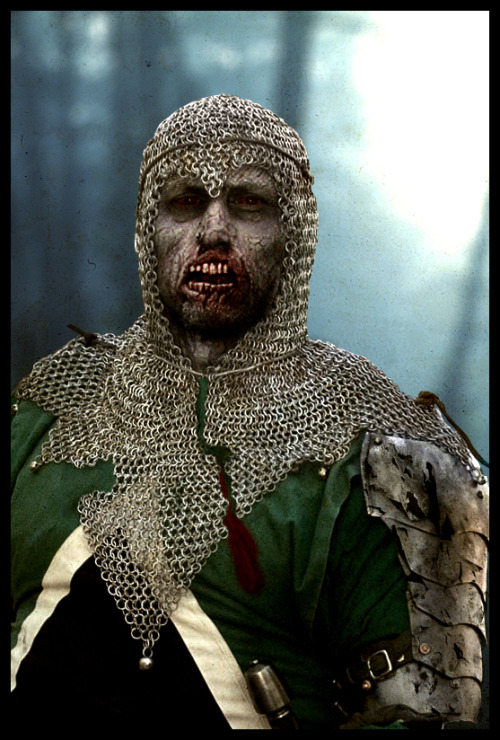
The wight of Waymar Royce
Do zombies have to be in everything?
This kind of storyline mimics the military histories of many nations, but if I wanted to read a long narrative about the military history of a nation, I would read a history of a nation. At least I could put those events in the context of the now. The real world has no dragons, no zombies, no magicians, no Seven Kingdoms.

This book is a soulless Lord of the Rings. In that series, people seemed to be fighting for a reason, and that reason keeps the narrative going. This book has no reason but to produce narrative. The quixotic plot twists bored me, as did the shallow characterization of most characters (save one or two characters I ended up liking, one of whom dies for no good reason). Political intrigue are the actions of insane or angry or sad people taking bloody vengeance on one another (the emphasis being on the bloodiness).

I suspect that the violence and sex is what attracts people to the novel and TV series.The slaughters and betrayals and rape scenes and incest and prophecies do not titillate me or even shock me. I've read Beowulf , the Nibelungenlied, Wagnerian opera, Shakespeare's history plays, and yes, The Lord of the Rings and Star Wars, among other literary texts, not to mention books on early European history.  I have read enough of this kind of revenge story already to have wanted something new from Martin's novel, and after 400 pages, I realized I wasn't going to find it.


If the series were shorter, and if I hadn't had as much reading experience under my belt as I have, I would have more patience. But the series goes on for four more books, and it seems likely to be four books of the same damn thing. I don't have time for this kind of repetition.

***
I have The Shack left to read as well as the TBA bestseller on the Globe and Mail bestseller list left to read. I have also acquired a copy of Must Read: Rediscovering American Bestsellers, which I hope to bring to bear here in the near future.